
 Checkout securely
Tunisgrad: Victory in Africa
Condition: New
Free UK delivery
Fri 16 Oct
Time until the order cutoff
Delivery details
Royal Mail 2nd Class — Free
Dispatch — when it leaves us
The arrival date shown is calculated from the order cutoff and delivery days.
Full delivery informationKeep up to six books on this device for 30 days. Prices and availability are checked when shown. Clear to remove the history and switch this off.
Free returns within 60 days
- Not completely happy?
- We’ll refund or replace your order within 60 days.
- Terms and exclusions apply. See our returns policy.
Description
On 8 November 1942, British and American troops invaded French North Africa as part of Operation Torch, the largest amphibious operation of the war to date. The Germans responded by flooding troops into Tunisia and the stage was set for one of the most decisive clashes of the war. When it ended, six months later, the Allies were masters of the North African shores.
It was, with Guadalcanal in the Pacific and Stalingrad in Russia, one of three Axis defeats in early 1943 that changed the course of the war. Historians have recognized the significance of the others, but not Tunisia which they have either ignored or characterized (as the Americans did at the time) as a sideshow. Yet it ended Axis seapower in the Mediterranean, destroyed more than 2,400 Axis aircraft (40 per cent of the Luftwaffes strength), and resulted in the surrender of over 250,000 German and Italian troops, more than were captured at Stalingrad. Such was the scale of their defeat that the German public wryly dubbed it Tunisgrad.
It was the first campaign fought by the Anglo-American alliance, and would determine how and where the Allies would fight for the rest of the war. It was where America first brought to bear the full weight of its industrial strength, and where the Allies learned, after early setbacks, how to defeat the Germans with a combination of air, land and sea power. It featured many of the great commanders of the Second World War, including Ike Eisenhower, George S. Patton Jr, Omar N. Bradley, Harold Alexander, Bernard Montgomery, and Erwin Rommel. But the campaigns chief significance is that it extinguished any lingering hopes in Italy that that that the war could be won and led, inexorably, to the dissolution of the Axis in Europe. By destroying the Axis it marked, for Hitler, the beginning of the end.
Tunisgrad is the first comprehensive 360-degrees history, told from the perspective of all the combatants, and ranging in focus from politicians and senior commanders to ordinary servicemen fighting in and over the mountains of Tunisia, and across the Mediterranean. Using a variety of first-hand sources, it restores the campaign to its rightful place as a defining moment of the war.
Book details
- Format:Hardback
- Pages:576 Pages
- Dimensions:240 x 159 x 39 mm
- Publication date:11 September 2025
- Publisher:HarperCollins Publishers
- Language:English
- ISBN10:000865381X
- ISBN-13:9780008653811
Related books
-

D-Day Through German Eyes: How the Wehrmacht Lost France
Jonathan Trigg Paperback £3.51£9.99Save £6.48 (65%)65% off! -

Arnhem: The Battle for the Bridges, 1944
Antony Beevor Paperback £3.06£12.99Save £9.93 (76%)76% off! -
Normandy 44: D-Day and the Battle for France
James Holland Paperback £3.35£12.99Save £9.64 (74%)74% off! -
Arnhem: Black Tuesday
Al Murray Paperback £2.83£10.99Save £8.16 (74%)74% off! -

Agincourt: Battle of the Scarred King
Dr Michael Livingston Paperback £9.89£10.99Save £1.10 (10%) -
Stalingrad
Antony Beevor Paperback £3.38£11.99Save £8.61 (72%)72% off! -
SAS: Rogue Heroes
Ben Macintyre Paperback £3.06£9.99Save £6.93 (69%)69% off! -
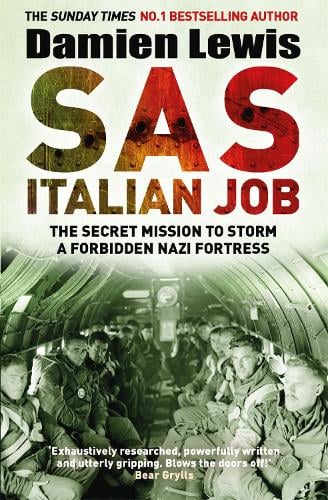
SAS Italian Job: The Secret Mission to Storm a Forbidden Nazi Fortress
Damien Lewis Paperback £3.29£12.99Save £9.70 (75%)75% off!